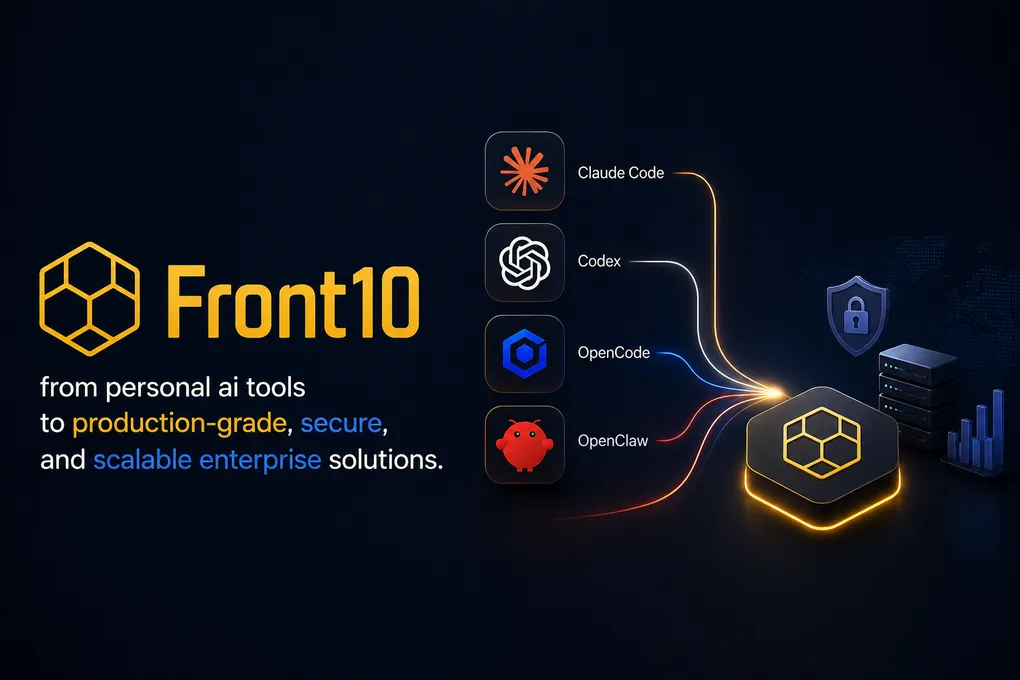
From Personal AI Automation to Production: When a Claude Code Script Becomes Enterprise Infrastructure
AI automation inside companies is increasingly starting somewhere unexpected.
Not with an enterprise transformation program.
Not with a six-month software project.
And often, not even with the IT department.
It starts with one employee.
Someone discovers Claude Code, Codex, OpenCode, OpenClaw, or another agentic tool and realizes that a repetitive part of their job can be automated.
A finance analyst builds a workflow that downloads reports, reconciles spreadsheets, identifies discrepancies, and prepares a summary every morning.
A sales operations specialist creates an agent that reviews incoming leads, enriches company information, updates the CRM, and drafts follow-up messages.
A marketing employee automates competitor monitoring, content research, campaign reporting, or the transformation of long-form material into dozens of social assets.
A customer-support manager creates a workflow that reads tickets, searches internal documentation, classifies requests, proposes answers, and escalates unusual cases.
An operations employee connects email, PDFs, spreadsheets, APIs, and an internal database to eliminate hours of manual processing.
A developer creates a Claude Code or Codex workflow that generates release notes, investigates production logs, updates dependencies, or validates deployments.
Initially, none of these systems needs to be an enterprise platform.
It only needs to solve one person’s problem.
And that is precisely why this new generation of AI automation is spreading so quickly.
The New Prototype Is a Working Automation
Traditional enterprise software projects usually begin with requirements.
Agentic automation often begins with something much more valuable:
a working solution.
An employee has already discovered the workflow.
They know which files are involved.
They know which APIs need to be called.
They have written the prompts.
They have configured MCP servers, scripts, commands, integrations, skills, or agents.
They may have iterated on the process dozens of times.
And most importantly, they already know that it creates business value.
Tools such as Claude Code, Codex, OpenCode, and OpenClaw dramatically reduce the cost of reaching this stage.
OpenCode, for example, supports configurable agents with different prompts, models, permissions, and tools. OpenClaw can run scheduled jobs, background tasks, event hooks, persistent instructions, and multi-step agent workflows.
The result is an important shift in enterprise software development:
employees can now prototype automation before the company decides to build software around it.
That is extremely powerful.
But it creates the next problem.
“This works perfectly for me. How do we make it available to the rest of the company?”
That question changes everything.
The Gap Between “It Works on My Laptop” and “It Runs the Business”
At Front10, we are increasingly seeing variations of this situation.
A client already has something useful.
Maybe it is a collection of Claude Code commands and skills.
Maybe it is a Codex-driven repository.
Maybe someone has built an impressive OpenClaw setup connected to several internal systems.
Maybe it is simply a Python or Node.js project surrounded by prompts, shell scripts, MCP integrations, and a surprisingly sophisticated set of instructions.
The prototype is not the problem.
Production is the problem.
A personal automation can fail at 2:00 AM and its creator fixes it the next morning.
A business automation may not have that luxury.
Once ten, fifty, or five hundred people depend on the same process, questions appear that did not matter during the prototype:
- What happens if a task takes 45 minutes and the server restarts after 43?
- Can an interrupted workflow resume without repeating completed operations?
- What happens when an API is temporarily unavailable?
- How are retries handled?
- Can two employees modify the same business record simultaneously?
- Where are credentials stored?
- Which employees can access which information?
- Can administrators see who executed an automation and what it changed?
- What happens when 200 jobs arrive simultaneously?
- Are files and intermediate results preserved?
- Can the system meet the company’s availability requirements?
- How are deployments rolled back?
- How are databases backed up?
- How do we observe token usage and infrastructure cost?
- What happens when the underlying AI provider changes a model or behavior?
- How do we prevent an agent from performing an action outside its authorization scope?
The automation has moved from personal productivity to software infrastructure.
And infrastructure has different rules.
A Realistic Scenario: The $50 Automation That Becomes a Business System
Consider a simulated example based on the type of problem companies increasingly encounter.
An employee at a logistics company receives dozens of documents every day.
They manually:
- Download attachments from email.
- Extract information from PDFs.
- Compare that information against an internal database.
- Identify inconsistencies.
- Update a spreadsheet.
- Prepare a summary.
- Send exceptions to an operations manager.
The employee builds a Claude Code workflow around a repository containing scripts, prompts, and API integrations.
Suddenly a process that required two hours takes ten minutes.
The company loves it.
Then management asks:
“Can all 25 operations employees use this?”
Technically, the answer might look simple.
Put it on a server.
Give everyone access.
Done.
But that would reproduce the prototype, not engineer a production system.
What happens when five people process documents simultaneously?
What happens when a 300-document batch fails halfway through?
Should the entire batch restart?
What happens if Claude successfully extracts the information but the ERP API fails immediately afterward?
How do we know whether the ERP update happened before retrying?
What documents can Employee A see compared with Employee B?
Where do the API credentials live?
Who can inspect previous jobs?
How long should execution history be retained?
What is the recovery procedure after infrastructure failure?
Suddenly the most important engineering work is no longer the prompt.
It is everything surrounding the prompt.
The Agent Is Only One Layer of the System
This distinction is essential when companies think about enterprise AI.
Claude Code, Codex, OpenCode, OpenClaw, and similar tools can provide extraordinarily capable agent runtimes.
But the runtime does not automatically become the entire enterprise architecture.
A production solution may need several additional layers:
Interface → Authentication → Authorization → API → Job Queue → Agent Workers → Business Systems → Persistent Storage → Observability
The agent lives inside that architecture.
It does not replace it.
For some automations, that architecture can remain surprisingly small.
For others, it can become a serious distributed system.
Knowing the difference is one of the most valuable parts of the engineering process.
Not Every Automation Needs Kubernetes
There is also a danger in moving from personal automation to enterprise software:
overengineering.
Suppose only six employees need the workflow.
Execution volume is moderate.
Tasks are relatively short.
There are no extremely strict regulatory requirements.
The existing automation already works reliably through an official CLI or supported runtime.
In that situation, rebuilding everything as microservices would probably be unnecessary.
A pragmatic architecture could be:
Web UI → Application API → Job Queue → Worker Pool → Existing Agent Automation
The original project can be placed in a proper repository, containerized, deployed to a VPS or cloud service, and surrounded by the minimum infrastructure necessary for production use.
Add:
- authentication;
- role-based permissions;
- PostgreSQL or another durable database;
- object storage for documents;
- distributed job processing;
- encrypted secrets;
- logs;
- backups;
- basic monitoring;
- retry policies;
- a simple frontend.
The worker can still execute the automation using the same agent environment where it was originally developed and validated, when the applicable provider terms and deployment model permit it.
Instead of rewriting months of experimentation, we productionize the proven workflow.
That can transform a personal automation into a controlled internal application surprisingly quickly.
When a Simple Queue Is No Longer Enough
Other processes require much stronger guarantees.
Imagine an automation that:
- processes thousands of documents;
- waits for external approvals;
- pauses for hours or days;
- coordinates multiple APIs;
- performs financial operations;
- requires human intervention at specific stages;
- must survive infrastructure failures;
- or needs a complete history of every transition.
At that point, treating the workflow as one large background script becomes dangerous.
This is where durable execution and orchestration platforms become valuable.
Technologies such as Temporal can model long-running workflows that survive process and infrastructure failures.
AWS Step Functions can orchestrate distributed workflows deeply integrated with AWS services.
Queue systems such as SQS, RabbitMQ, Redis/BullMQ, Kafka, or cloud-native equivalents can separate ingestion from execution and allow worker capacity to scale independently.
For integration-heavy business processes, n8n may provide a faster visual orchestration layer.
For specialized requirements, a custom application may still be the best solution.
The architecture should follow the business problem rather than the current popularity of a technology.
From Prompt to Durable Workflow
One of the most important transformations during productionization is turning implicit agent behavior into explicit system behavior.
A personal agent might receive:
“Review today’s invoices, compare them with our purchase records, flag inconsistencies, and send me the report.”
For one employee, that may be enough.
At enterprise scale, we need to understand the actual workflow:
Receive → Validate → Extract → Normalize → Match → Evaluate → Persist → Notify
Now each stage can have defined behavior.
What can be retried?
What must be idempotent?
Which operations require human approval?
What state must be persisted?
Which failures can be ignored?
Which failures must stop the workflow?
Which actions need an audit record?
Which information can be passed to an AI model?
This is the moment when an impressive AI trick becomes dependable software.
Skills Can Become Business Assets
Another interesting consequence of this movement is that organizations are beginning to accumulate reusable agent knowledge.
A well-designed Claude Code command, Codex instruction set, OpenCode agent configuration, OpenClaw skill, MCP integration, or internal prompt library is not merely a prompt.
It can represent encoded operational knowledge.
For example:
invoice-reconciliation
could contain:
- company-specific reconciliation rules;
- document-processing instructions;
- ERP integrations;
- exception thresholds;
- validation logic;
- reporting formats;
- escalation policies.
Likewise:
customer-renewal-analysis
could combine CRM data, billing information, support history, account activity, and internal business rules.
These capabilities can be packaged as reusable skills or services rather than repeatedly rebuilt for individual employees.
The company gradually creates an internal automation layer composed of domain-specific capabilities.
The real intellectual property is increasingly located there:
not in the generic agent, but in the business knowledge encoded around it.
Do Not Sell the Agent. Build the Solution.
There is an important product and legal distinction here.
Companies should be careful about turning individual subscriptions, personal credentials, or third-party agent interfaces into unofficial multi-user services.
Provider terms differ, licenses evolve, and account-based products may impose restrictions on credential sharing, account resale, or redistribution.
The safer and more durable architectural principle is:
Do not make somebody else’s AI account your product. Make your business process your product.
If your system automatically reconciles insurance claims, the product is claims reconciliation.
If it reviews construction documents against company requirements, the product is document compliance automation.
If it processes incoming purchase orders, the product is purchase-order automation.
If it monitors hundreds of accounts and identifies renewal risks, the product is renewal intelligence.
The underlying implementation might use Claude, OpenAI models, OpenCode, OpenClaw, APIs, official SDKs or CLIs, or several providers simultaneously.
But those technologies are implementation components.
The solution is the business capability.
This distinction also makes the architecture more resilient.
If tomorrow a model changes, a CLI evolves, pricing changes, or another provider becomes more appropriate, the business workflow should not need to disappear with it.
From One User to Many: Identity Changes Everything
Personal agents normally inherit the identity of their owner.
Enterprise systems cannot.
Suppose an automation has access to:
- Gmail;
- Google Drive;
- Salesforce;
- HubSpot;
- databases;
- ERP systems;
- Slack;
- accounting platforms;
- internal APIs.
When one employee runs it locally, their identity implicitly determines what the automation can see.
When 100 employees access the same automation, that assumption becomes dangerous.
Production systems need explicit identity boundaries.
Depending on the application, that might mean:
- SSO;
- OAuth;
- role-based access control;
- organization and team boundaries;
- per-user credentials;
- service accounts;
- scoped tokens;
- tenant isolation;
- centralized secret management;
- detailed audit trails.
The question is no longer simply:
“Can the agent access Salesforce?”
It becomes:
“Which Salesforce records can this user cause the agent to access, and which actions can it perform on their behalf?”
That is a fundamentally different engineering problem.
Long-Running AI Requires Durable State
AI automation also introduces an unusual infrastructure challenge.
Agent jobs can be long.
They may perform dozens or hundreds of tool calls.
They may generate intermediate files.
They may wait for APIs.
They may need human approval.
They may consume substantial computational or model resources before reaching completion.
Losing a 40-minute execution because a container restarted is not merely inconvenient.
It can be expensive and potentially dangerous if some external actions were already completed.
Production architectures therefore need to consider:
durability, checkpoints, idempotency, retries, resumability, and state persistence.
A workflow should know not only what it intends to do, but what it has already done.
This becomes particularly important when agents interact with systems that have side effects:
create invoice
send email
issue refund
update customer
modify inventory
publish content
“Retry everything” is not a valid failure strategy.
The Three Productionization Paths We Commonly See
In practice, these projects tend to fall into three broad categories.
1. Productionize the Existing Agent
Best when the automation already works well and usage is limited.
Keep most of the existing implementation.
Add a repository, deployment pipeline, authentication, database, queue, frontend, backups, monitoring, and controlled execution environment.
This is often the fastest route from prototype to internal product.
2. Agent + Workflow Platform
Best for integration-heavy processes.
Keep AI for reasoning and unstructured work, but move deterministic orchestration into platforms such as n8n or cloud-native workflow services.
The workflow platform handles predictable transitions.
The agent handles ambiguity.
This separation can dramatically improve reliability.
3. Custom Distributed Automation Platform
Best for high-volume or mission-critical operations.
Here the original automation becomes the specification for a more sophisticated architecture.
The solution might include:
- event-driven services;
- durable workflow engines;
- distributed queues;
- horizontally scalable agent workers;
- relational and object storage;
- caching;
- API gateways;
- centralized identity;
- observability;
- cost controls;
- human-in-the-loop interfaces;
- disaster recovery;
- infrastructure as code.
The original Claude Code or Codex automation has not been wasted.
Quite the opposite.
It served as an extremely inexpensive prototype of the business logic.
AI Has Changed the Economics of Internal Software
This may be the larger transformation.
For decades, many internal business problems were too small to justify custom software.
If a process wasted 10 hours per week, developing a dedicated application might still have been economically irrational.
So employees lived with spreadsheets, copy-paste operations, email chains, macros, and manual reconciliation.
Agentic tools change that equation.
An employee can now experiment with automation in hours.
A useful workflow can emerge in days.
Management can evaluate its actual value before investing in infrastructure.
Only successful automations need to graduate into production.
This creates a new software lifecycle:
Manual Process → Personal AI Automation → Proven Business Value → Production Engineering → Enterprise Platform
Instead of asking developers to automate hypothetical processes, organizations can discover automation opportunities organically through their own employees.
The winners become obvious because people are already using them.
A New Role for Software Engineering Companies
This does not make professional software engineering less important.
It changes where professional engineering begins.
Previously, a company might approach a development partner with:
“We have this manual process. Can you build software to automate it?”
Increasingly, the conversation becomes:
“One of our employees already automated this with Claude Code. It works. Now we need 80 people to use it safely.”
That is a much better starting point.
The business problem is understood.
The workflow has been tested.
The value has been demonstrated.
What remains is turning experimentation into infrastructure.
That requires architecture, security, DevOps, product engineering, data engineering, UX, observability, reliability, and ongoing support.
In other words:
AI agents can dramatically accelerate invention. Professional engineering makes that invention operational.
How Front10 Approaches These Projects
At Front10, this intersection between AI automation and production software is becoming an increasingly important part of the work we do.
Our role is not to discard what a client has already built simply because it began as a personal Claude Code, Codex, OpenCode, or OpenClaw workflow.
Quite often, that prototype contains the most valuable part of the project:
months of accumulated knowledge about how the business actually operates.
We begin by understanding that automation.
What problem does it solve?
Which parts depend on agent reasoning?
Which parts should become deterministic?
What data does it touch?
How many users need it?
What happens when it fails?
How long can jobs run?
What security boundaries exist?
What availability does the business actually require?
Only then do we decide how much infrastructure is justified.
Sometimes the correct solution is surprisingly lean: preserve the existing agent workflow, containerize it, add a small application layer, durable storage, authentication, queues, monitoring, and deploy it professionally.
Sometimes n8n provides the right orchestration layer.
Sometimes we need Temporal or cloud-native workflow infrastructure.
Sometimes the correct answer is a custom distributed platform with specialized workers and enterprise-level observability.
And sometimes we can package the existing domain knowledge into reusable skills and integrations that become the foundation for several automations instead of just one.
There is no reason to turn every successful script into a million-dollar software platform.
But there is also no reason to operate a mission-critical business process from an employee’s laptop.
The engineering challenge is knowing where that boundary lies.
From “My AI Does This” to “Our Company Runs on This”
We believe this transition will become increasingly common.
Across companies everywhere, employees are quietly building small automations with powerful AI agents.
Most will remain personal productivity tools.
Some will disappear.
But a small percentage will prove so valuable that organizations will inevitably ask:
Can we make this available to everyone?
That question marks the beginning of a new category of enterprise software project.
The objective is no longer to invent the automation from scratch.
It is to preserve what already works while adding everything required for production:
reliability, scalability, security, identity, durability, observability, maintainability, usability, and support.
At Front10, we help companies cross that gap.
We take successful AI experiments, agent workflows, internal tools, and employee-built automations and help transform them into professional digital products that teams can actually depend on.
Because the most valuable enterprise AI solution may already exist.
It may simply be running on someone’s laptop.
And the next step is not another prompt.
It is production engineering.