Front10 2025: A Year of Generative AI Innovation and Strategic Evolution
A Year of Transformation
2025 has been a pivotal year for Front10. What began as a strategic decision to embrace generative AI has evolved into a comprehensive transformation of our company, our products, and our approach to building digital solutions. This year-end recap reflects on the journey, the achievements, and the vision that continues to drive us forward.
The Strategic Pivot: Embracing Generative AI
At the beginning of 2025, we made a deliberate and strategic decision: Front10 would become a leader in Generative AI-powered solutions. This wasn’t a pivot away from our UI/UX expertise—it was an evolution that leveraged our deep understanding of user interfaces to pioneer a new category of intelligent, adaptive applications.
From UI Experts to Gen-UI Pioneers
Our transition to Generative UI (Gen-UI) represents the natural evolution of our capabilities. With years of experience building high-quality, accessible, and performance-driven user interfaces, we recognized that the future of software interaction lies in interfaces that understand context, anticipate needs, and adapt dynamically to users.
This strategic bet has positioned Front10 at the intersection of design systems, AI models, and real-time user interaction—a space where we thrive and where our clients find unprecedented value.
Our Work in 2025: A Technical Deep Dive
Throughout 2025, we’ve published extensive technical content documenting our journey, learnings, and innovations. Here’s a comprehensive overview of the work we’ve accomplished:
1. Generative UI: The Foundation
Our exploration of Generative User Interfaces has been comprehensive and forward-looking. We’ve documented:
-
The State of Gen-UI in 2025: A deep analysis of how Generative UI has matured from experimental prototypes to foundational layers in modern products. We explored real-time design iteration, mass personalization, contextual adaptivity, and the emergence of Gen-UI as a strategic differentiator in AI products.
-
Technical Implementation Patterns: Through our work on chatbot artifacts, we’ve documented production-ready patterns for building generative UI components—from document viewers and vector search results to smart citations, data sheets, and interactive visualizations. Our technical deep dive covered streaming implementations, React rendering optimization, TypeScript type safety, and performance best practices.
-
Comparative Analysis: We conducted a thorough comparison of Generative UI libraries—evaluating Vercel AI SDK, LangGraph, Assistant-UI, Crayon, and others—providing strategic recommendations for building scalable, intelligent Gen-UI systems.
-
Study Guide and Resources: We created a comprehensive study guide for developers wanting to systematically follow the Generative UI field, curating research papers, articles, RSS feeds, and social accounts to stay current with the latest developments.
2. WOXO: Building an AI Product People Actually Use
WOXO, our AI-powered platform that transforms text prompts into complete YouTube Shorts, has been a testament to our philosophy of building useful, not just impressive, AI tools.
Key Achievements:
-
70% Day-One Video Creation Rate: Seven out of ten new users successfully create a video on their first day—a metric that validates our focus on immediate utility over flashy features.
-
Sustainable Growth:
- 8.85% MRR Growth month-over-month, demonstrating consistent, sustainable business growth
- 15.52% Active Subscriber Growth, showing strong retention and product stickiness
- 10,200 Videos Generated in a single week, proving real-world usage at scale
These metrics reflect our commitment to building AI tools that solve real problems, not just generate headlines. WOXO has become a production tool integrated into creators’ workflows, not a novelty that users try once and abandon.
3. Advanced AI Solutions: Real-World Applications
Our work this year has extended far beyond theoretical exploration. We’ve built production systems that demonstrate the practical power of generative AI:
AI-Powered User Feedback Monitoring System
We developed a sophisticated multi-agent AI system using the Mastra.ai framework for WOXO, automating user feedback monitoring across multiple channels:
- Multi-Channel Processing: Integrated Gmail, Discord, and MongoDB feedback sources
- Intelligent Categorization: Automated classification into actionable categories (Cancellation, Refund, Extra Credit Requests, Issues/Bugs, Product Feedback)
- Temporal Analysis: Maintained consistency across time periods for trend analysis
- Business Impact: Achieved a 97% reduction in manual processing time (from ~70 hours/month to ~2 hours/month)
Hybrid Intelligence for Excel Processing
We solved a critical challenge in document processing by developing a hybrid approach combining heuristics and LLMs for Excel table detection:
- Solved Attention Bias Problem: Addressed the “lost-in-the-middle” issue in LLM processing
- Achieved 94% Precision and 91% Recall: Significantly outperformed both pure heuristic and pure LLM approaches
- Production-Ready Solution: Handles complex financial documents, invoices, and reports with high accuracy
Google Calendar Assistant
We built a complete Google Calendar Virtual Assistant demonstrating the power of our @front10/generative-ui package:
- Natural Language Calendar Management: Full CRUD operations through conversation
- Adaptive Interfaces: Dynamic views that adjust based on context
- Intelligent Optimization: Availability checking, conflict detection, and optimal meeting time suggestions
- Extensible Architecture: Pattern applicable to medical appointments, restaurant reservations, and resource scheduling
4. Technical Innovation and Learning
AI SDK Exploration
Our experimentation with Vercel’s AI SDK led to valuable insights about building AI-powered applications quickly:
- Structured Output: Demonstrated the power of getting structured data from LLMs instead of plain text
- External Tools Integration: Showed how connecting APIs gives AI applications new capabilities
- Rapid Prototyping: Proved that functional AI features can be built with minimal code
React and Generative AI
We documented how React is evolving to support generative AI scenarios:
- React Server Components: Enabling LLMs to generate component trees
- Ecosystem Integration: How libraries like assistant-ui, CopilotKit, and KaibanJS enable AI-powered UIs
- Future Outlook: React’s role in the next wave of AI-powered applications
Strengthening WOXO as a Product
WOXO’s growth this year has been remarkable, but more importantly, it’s been sustainable and meaningful. The metrics we track—day-one video creation, MRR growth, active subscribers, and usage volume—all point to the same conclusion: we’ve built an AI tool that people actually use.
The philosophy behind WOXO reflects Front10’s broader approach: build tools that solve real problems, not products that generate headlines. In an AI space where hype cycles come and go, sustainable growth comes from utility, not novelty.
Our focus on immediate utility, sustained value, and real-world usage has validated that AI tools can deliver genuine value when built with the right priorities.
Company Evolution: Website and Blog
Website Transformation
This year, we undertook a significant update to our corporate website, refocusing it entirely on our generative AI capabilities and expertise. The new site reflects our strategic commitment to AI-first development and showcases:
- Our Generative UI capabilities and thought leadership
- Technical expertise in building AI-powered applications
- Real-world case studies and implementations
- Clear positioning as AI-native product developers
This transformation wasn’t just cosmetic—it represented a fundamental shift in how we present ourselves to the market and how we attract clients who are serious about integrating AI into their products.
The Birth of This Blog
The creation of this blog space was a deliberate decision to share our work, our learnings, and our technical insights with the broader community. We recognized that the field of Generative UI and AI-powered applications is rapidly evolving, and we wanted to contribute to the collective knowledge.
This blog has become a platform for:
- Technical Deep Dives: Comprehensive articles on implementation patterns, architecture decisions, and best practices
- Real-World Case Studies: Documentation of actual systems we’ve built and the challenges we’ve solved
- Thought Leadership: Analysis of industry trends, comparative studies, and strategic recommendations
- Learning Resources: Study guides, tool comparisons, and practical examples
Through this blog, we’ve connected with developers, product leaders, and CTOs who are exploring how to integrate AI-native experiences into their solutions. It’s become a valuable resource for the community and a reflection of our commitment to knowledge sharing.
Recognition from OpenAI
One of the most significant milestones of 2025 was receiving recognition from OpenAI for surpassing 10 Billion Tokens processed on their platform.
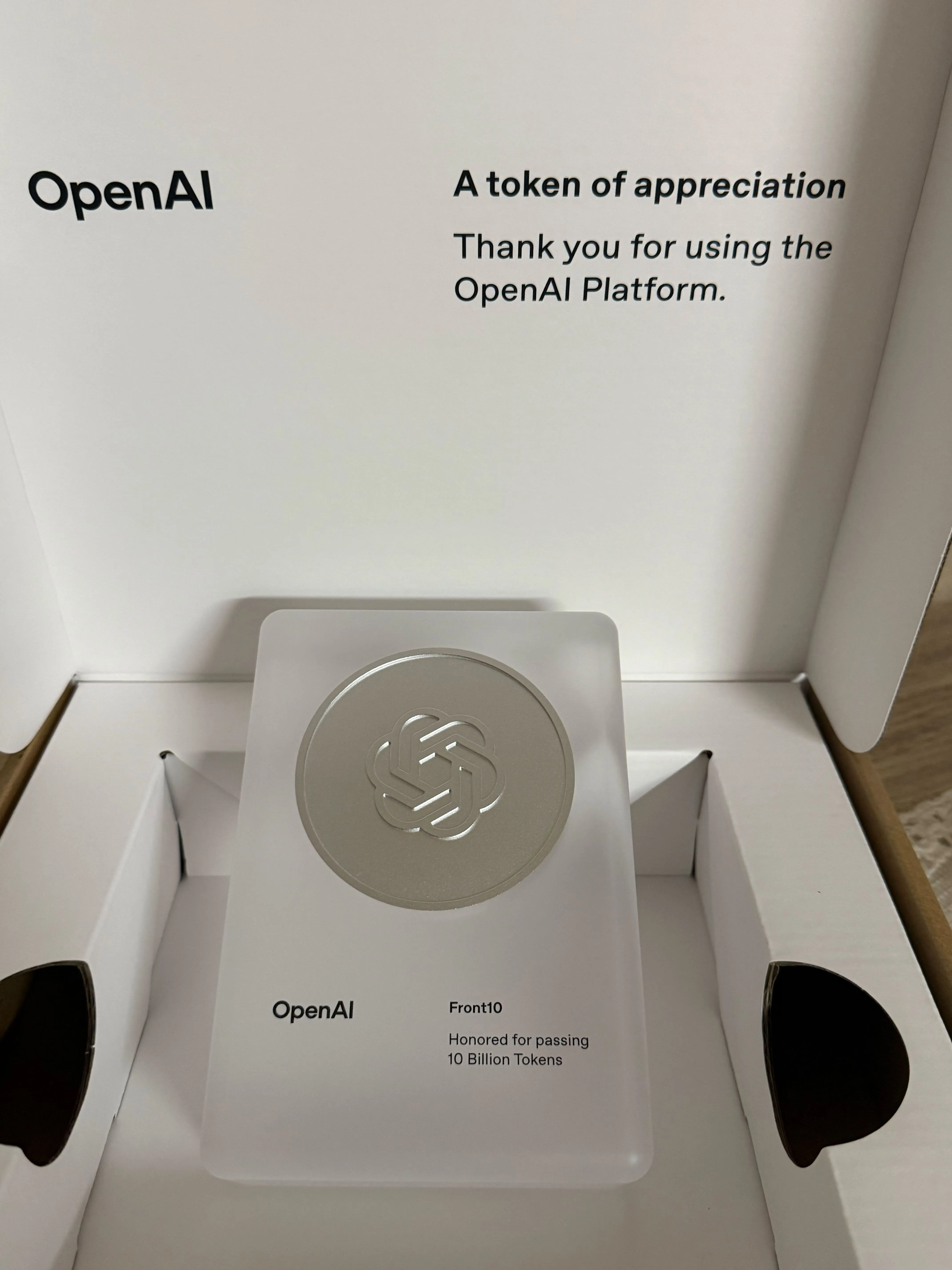
This recognition is more than an achievement—it’s validation of our early commitment to AI and our ability to build production systems at scale. Processing 10 billion tokens represents:
- Real-World Production Usage: Not experiments or demos, but actual systems serving real users
- Scale and Trust: The confidence to build critical business systems on AI infrastructure
- Early Adoption: We’ve been building with AI since 2022, well before it became mainstream
This milestone reflects our deep experience with AI systems and positions us as a trusted partner for organizations looking to build serious AI-powered products.
Looking Forward: Projections for 2026
As we close 2025, our commitment to generative AI is stronger than ever. Our projections for 2026 reflect our intention to continue leading in this space:
Continued Innovation in Generative UI
We will continue to push the boundaries of what’s possible with Generative UI:
- Advanced Component Patterns: Developing new patterns for more complex, interactive generative components
- Performance Optimization: Further improvements in streaming, rendering, and user experience
- Accessibility and Ethics: Ensuring generative interfaces are accessible, transparent, and trustworthy
Strengthening Our Product Portfolio
WOXO will continue to evolve based on user feedback and usage patterns. We’ll focus on:
- Enhancing the core video generation experience
- Expanding use cases and vertical applications
- Improving retention and user satisfaction metrics
Expanding AI Solutions
We’ll continue building production AI systems for clients, applying the patterns and learnings from 2025 to new challenges:
- Multi-Agent Systems: More sophisticated agent orchestration for complex workflows
- Document Intelligence: Expanding our document processing capabilities
- Conversational Interfaces: Building more advanced chatbot and assistant systems
Thought Leadership and Community
This blog will continue to be a platform for sharing our work:
- Technical Content: More deep dives into implementation details and architectural decisions
- Case Studies: Documentation of new projects and solutions
- Industry Analysis: Continued analysis of trends and emerging technologies
Delivering State-of-the-Art Solutions
Our commitment to our clients and future clients is clear: we will continue to deliver products that are at the state of the art, aligned with the latest technologies around AI development and IT solutions.
This means:
- Staying current with the latest AI models, frameworks, and tools
- Applying cutting-edge patterns to real business problems
- Building systems that are not just functional, but exceptional
- Ensuring our solutions are maintainable, scalable, and future-proof
The Philosophy Behind Our Work
Throughout 2025, a consistent philosophy has guided our work:
-
Utility Over Hype: We build tools that solve real problems, not products designed to generate press coverage.
-
Production-First: Every system we build is designed for real-world usage at scale, not just demos or prototypes.
-
Technical Excellence: We document our work, share our learnings, and contribute to the community’s collective knowledge.
-
Strategic Evolution: We evolve our capabilities proactively, staying ahead of industry trends rather than reacting to them.
-
Client Success: Our success is measured by the value we deliver to clients, not just our own achievements.
Conclusion: Building the Future
2025 has been a transformative year for Front10. We’ve evolved from a UI-focused agency to a leader in Generative AI solutions. We’ve built production systems that process billions of tokens, serve real users, and solve actual business problems. We’ve strengthened WOXO into a product that people actually use. We’ve created a platform for sharing knowledge and connecting with the community.
Most importantly, we’ve established a foundation for continued innovation and growth in 2026 and beyond.
The recognition from OpenAI, the growth of WOXO, the technical content we’ve published, and the systems we’ve built—all of these achievements point to one thing: Front10 is not just participating in the AI revolution; we’re helping to shape it.
As we look to 2026, we’re excited to continue this journey. We’ll keep building state-of-the-art solutions, sharing our learnings, and helping our clients and future clients leverage the power of generative AI to transform their businesses.
The future of software is intelligent, adaptive, and generative. At Front10, we’re not just ready for that future—we’re building it.
To our clients, partners, and the community: Thank you for being part of this journey. Here’s to an even more innovative and impactful 2026.
Let’s continue shaping the future of user interaction together. 🚀